
DATE
MAY 7, 2027
TIME
9:00 am - 1:30 pm CDT
COURSE FEE
$180
CONTINUING EDUCATION
4 CE DIAGNOSING HOURS NBCC APPROVED · 4 CE CLINICAL HOURS OFFERED BY ASWB ACE
Course overview
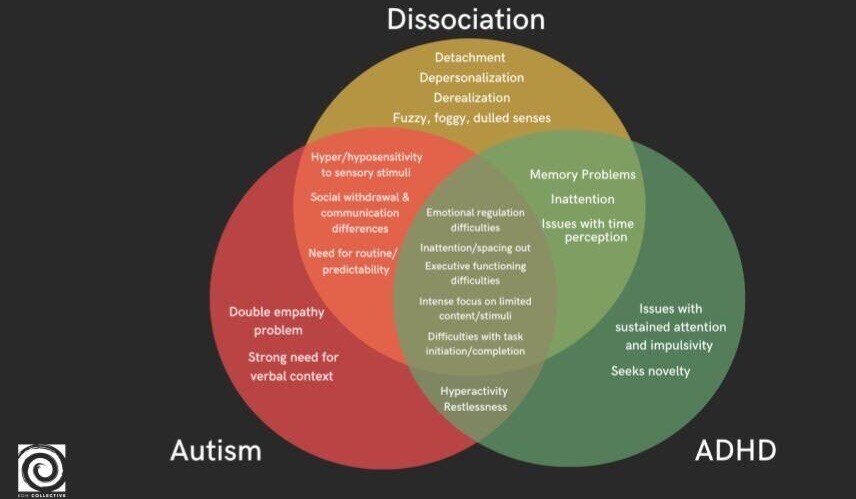
Examine the overlap between trauma, dissociation, autism, and ADHD without letting one diagnosis obscure another. Build practical assessment and stabilization approaches that account for sensory and executive-function needs.
CLASS OBJECTIVES:
By the end, participants will be able to:
- Identify how diagnostic overshadowing leads to both (a) misattributing dissociation/trauma responses to Autism/ADHD and (b) misattributing Autism/ADHD to trauma‑related dissociation.
- Map sensory profiles (hyper/hypo) and ADHD differences to window of tolerance shifts (hyperarousal ↔ hypoarousal) and tailor stabilization.
- Differentiate dissociation from ADHD inattention, autistic shutdown, and sensory overwhelm.
- Apply neurodiversity‑affirming stabilization (OT‑informed sensory tools, pacing, DBT/RO‑DBT skills).
Full course description
This workshop addresses diagnostic overshadowing in trauma and neurodivergence: situations in which trauma responses are attributed only to autism or ADHD, or neurodevelopmental differences are interpreted only through a trauma lens. The course emphasizes diagnostic clarity and functional stabilization.
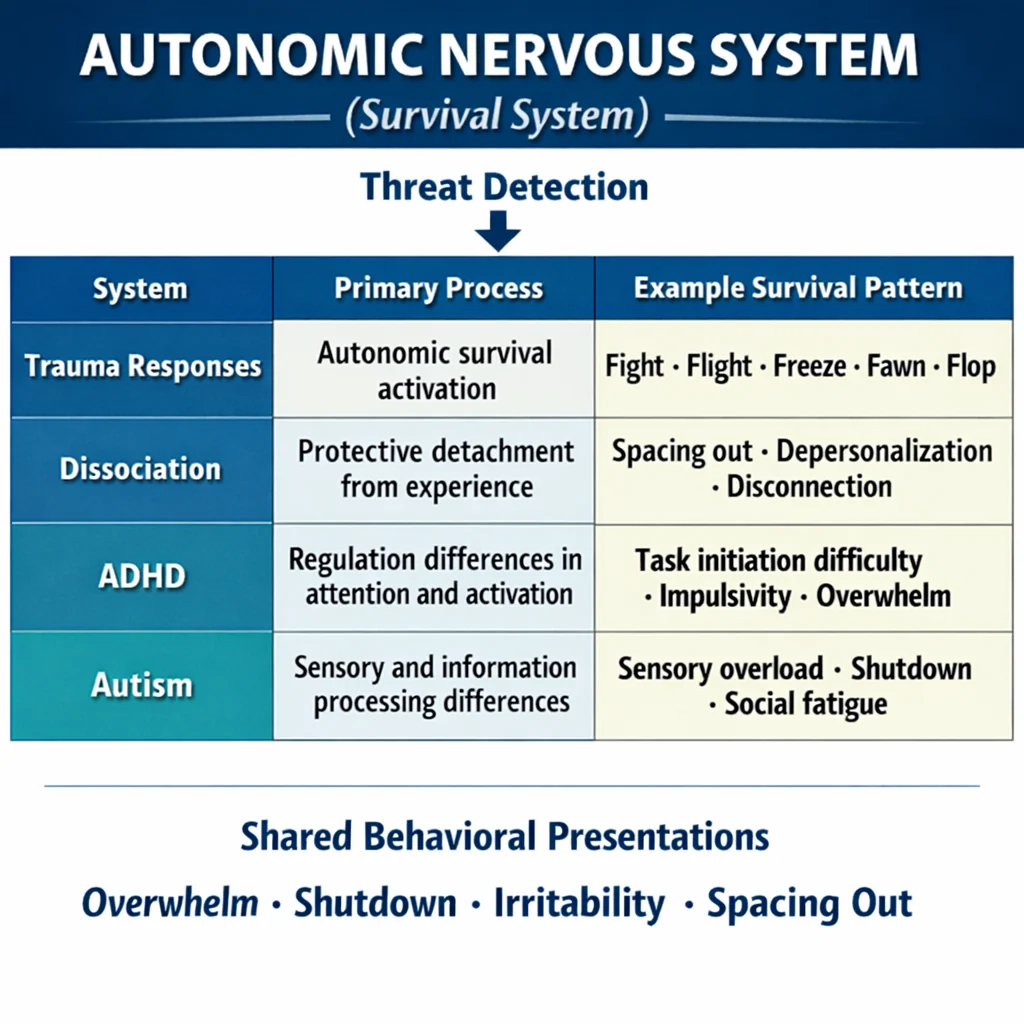
Participants examine autonomic defense responses, monotropism, attentional patterns, executive-function overload, and sensory regulation. Assessment tools and practical supports are considered alongside neurodivergent adaptations to the Window of Tolerance, DBT/RO-DBT skills, sensory supports, session pacing, and homework planning.
Topics and agenda
Clinical topics
- Dissociation, ADHD inattention, and autistic absorption
- Autistic meltdown and shutdown; ADHD agitation and collapse
- Trauma physiology, executive functioning under stress, and monotropism
- Assessment tools introduced in the course: DES, ASRS, PCL-5, and CAPS-5
- Neurodivergent-adapted Window of Tolerance and sensory hyper/hypo profiles
- DBT/RO-DBT stabilization skills, sensory kits, OT-informed supports, pacing, and accessible homework
Class agenda
9:00-10:00 Identify how diagnostic overshadowing leads to both (a) misattributing dissociation/trauma responses to Autism/ADHD and (b) misattributing Autism/ADHD to trauma‑related dissociation.
10:00-11:00 Map sensory profiles (hyper/hypo) and ADHD differences to window of tolerance shifts (hyperarousal ↔ hypoarousal) and tailor stabilization.
11:00-11:30 Break
11:30-12:30 Differentiate dissociation from ADHD inattention, autistic shutdown, and sensory overwhelm.
12:30-1:30 Apply neurodiversity‑affirming stabilization (OT‑informed sensory tools, pacing, DBT/RO‑DBT skills).
Who should attend
This neurodivergent and trauma continuing education training is appropriate for:
- LPCs
- LCSWs
- LMFTs
- Psychologists
- Clinical interns seeking advanced conceptual clarity
Participants should have foundational familiarity with trauma-informed care and neurodevelopmental conditions.
Diagnose less, understand more. Practical skills to differentiate dissociation from ADHD/Adult Diagnosed Autism and help clients stabilize, effectively.
CONVERSATIONS FROM THE COLLECTIVE
Explore the video library.
Neurodivergence in the Therapy Room
KD and Whitney share practical, neurodiversity-affirming strategies for supporting clients in therapy.
Neurodivergence: Autism
Whitney and Monet discuss autism, masking, and neurodiversity-affirming approaches in the therapy room.
Neurodivergence: ADHD
Monet and Whitney share practical insights into ADHD and supporting neurodivergent clients in therapy.
FREE EBOOK
ARE YOU INTERESTED IN GAINING FURTHER KNOWLEDGE FROM OUR EBOOK ON NEURODIVERGENCE? This e-book is provided for educational and informational purposes only. It is not a substitute for professional supervision, training, or therapy. The content reflects current knowledge in the field of neurodivergence and related clinical practices, but it does not constitute formal continuing education credit.
ENROLL IN NEURODIVERGENT: TRAUMA
$180 for 4 CE Hours
LEARN MORE FROM OUR PODCAST:
LISTEN TO KDH PODCASTMeet your instructor.
KD Holmes, MS, LPC, EMDR Certified, BTTI Trained
KD (she/her) is a practicing therapist at KDH Counseling for the past 20 years. She specializes in Anxiety Disorders, Phobias, OCD, and PTSD.
Full bio
Founder of KDH Collective & KDH Counseling
KD (she/her) is a practicing therapist at KDH Counseling for the past 20 years. She specializes in Anxiety Disorders, Phobias, OCD, and PTSD. She is certified in Eye Movement Desensitization and Reprocessing, and trained in BTTI for OCD treatment. KD utilizes biology as a foundation to guide behavioral approaches to mental health treatment, using DBT, RODBT, and ERP to address issues through tangible steps. Trauma reprocessing techniques like EMDR, and Deep Brain Reorienting are valuable tools to transform the nervous system and address trauma responses. The wisdom of biology, practitioner experience, data, and protocols lead to the best outcomes for clients and professional development.
CE approval details
ASWB ACE / Provider No. 2506

KDH COLLECTIVE PROVIDER #2506
KDH COLLECTIVE PROVIDER #2506, IS APPROVED TO OFFER SOCIAL WORK CONTINUING EDUCATION BY THE ASSOCIATION OF SOCIAL WORK BOARDS (ASWB) APPROVED CONTINUING EDUCATION (ACE) PROGRAM. REGULATORY BOARDS ARE THE FINAL AUTHORITY ON COURSES ACCEPTED FOR CONTINUING EDUCATION CREDIT. ACE PROVIDER APPROVAL PERIOD: 09/30/2026 - 09/30/2029. SOCIAL WORKERS COMPLETING THIS COURSE RECEIVE 4 CLINICAL CONTINUING EDUCATION CREDITS.
NBCC / ACEP No. 7323

KDH COLLECTIVE ACEP NO. 7323
KDH COLLECTIVE HAS BEEN APPROVED BY NBCC AS AN APPROVED CONTINUING EDUCATION PROVIDER, ACEP NO. 7323. PROGRAMS THAT DO NOT QUALIFY FOR NBCC CREDIT ARE CLEARLY IDENTIFIED. KDH COLLECTIVE IS SOLELY RESPONSIBLE FOR ALL ASPECTS OF THE PROGRAMS.
Registration and accessibility
For LPCs, LMHCs, LCPCs, PLPCs, LMSWs, LCSWs, LMFTs, and other state-credentialed counselors
ADA NEEDS
We would be happy to accommodate your needs.
Contact us:
337-895-0300 [email protected]Registration Deadline closes at the beginning of course.
This live webinar is hosted through zoom. Participants are responsible for ensuring their device and internet connection meet Zoom’s current system requirements.
Your information is handled according to our Privacy Policy.
Questions and concerns
Your satisfaction is our goal and our guarantee. Concerns should be addressed to:
KDH Collective 4906 Ambassador Caffery Pkwy, Bldg I Lafayette, La 70508 337-895-0300 [email protected]Refund policy
We work hard to ensure the quality of our courses and educational materials. If you would like a refund, please email your request with an explanation to [email protected]within 48 hours of the live course, and we will review the refund request.
Attendance and certificate requirements
To successfully complete this course and receive a certificate of completion / continuing education credit, participants must:
-
Attend the full live webinar course from start to finish.
-
Submit evaluations forms. (Completion of the evaluation is a required step before certificates are issued.)
- CE credit certificates will be emailed within a week of attending course and completing evaluations.